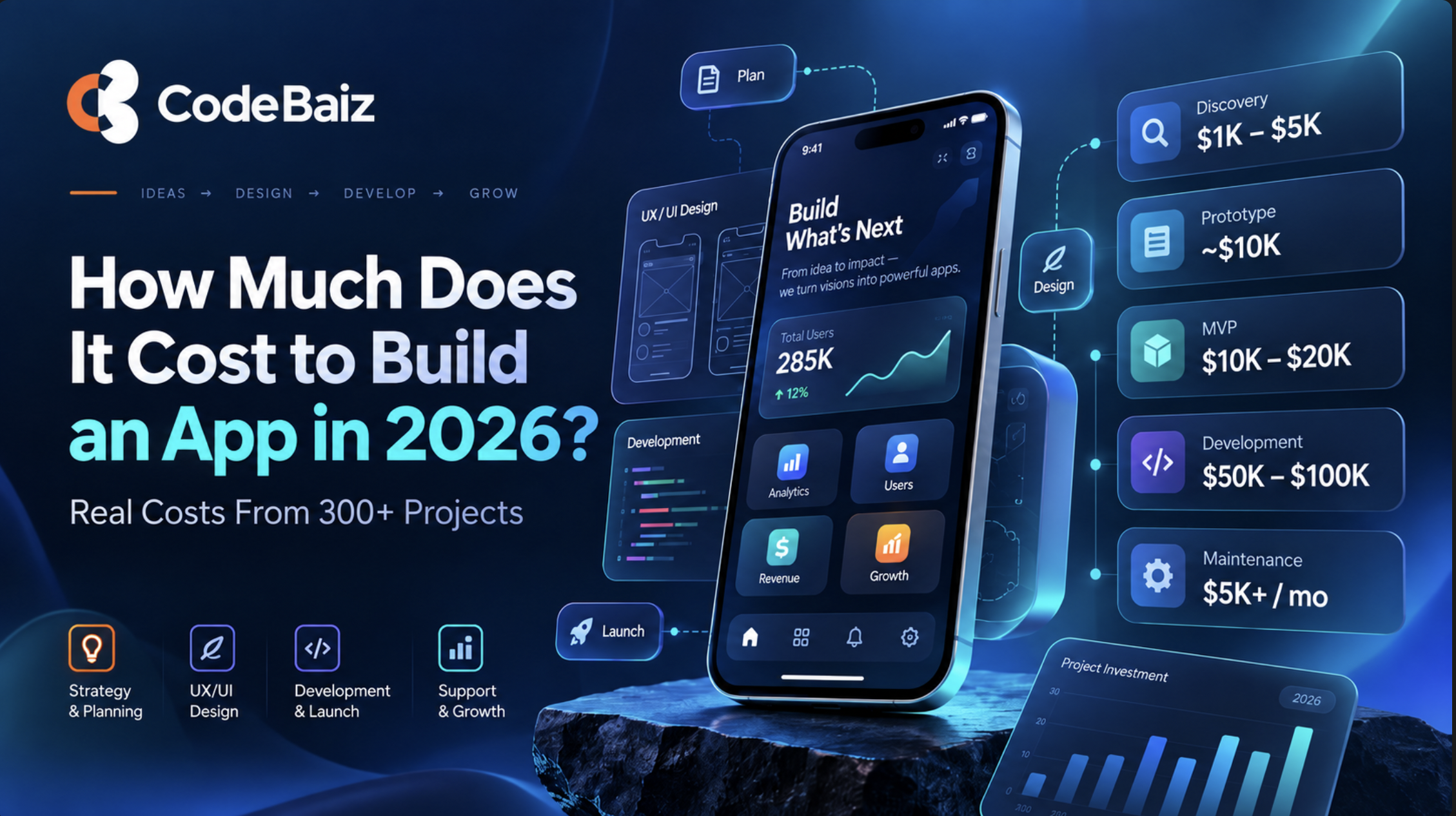
If you want the short answer:
A properly built, production-grade app will usually cost somewhere between $60,000 and $120,000+ to get from idea to launch.
An MVP can be much cheaper. In 2026, many MVPs can realistically be built for $10,000 to $20,000, especially with AI speeding up development.
But those are two very different products. We have worked on 300+ software projects since 2019, so the numbers below are not hypothetical estimates pulled from a pricing calculator. They are much closer to what you should actually expect when building software with an experienced team.
Before getting into the total, though, it helps to understand where the money actually goes. For most apps, the work can be divided into four major stages:
Discovery
Prototyping and UX/UI design
Development
Post-launch maintenance and growth
Let's break each one down.
1. Discovery: $1,000 to $5,000
Discovery is one of the most overlooked parts of software development. And ironically, it is often the stage that saves the most money later. This is where the team figures out what is actually being built. Not just:
"We need an Uber for X."
But questions like:
Who are the different types of users?
What can each user do?
What happens when something goes wrong?
How do payments work?
What happens if a transaction fails?
What does an administrator need to control?
What notifications need to be sent?
What data needs to be stored?
Which third-party systems need to be integrated?
A good development team will spend significant time walking through these scenarios with you. By the end of discovery, you should have detailed documentation explaining the product, its major features, user flows, integrations, edge cases, and technical requirements.
You should also have a shorter brief that lets you understand the entire system without drowning in 100 pages of documentation.
For a reasonably sized application, discovery normally takes at least one to two weeks. We are not talking about a simple to-do app here. And we are also not talking about building the next AWS.
For a typical startup product, expect discovery to cost approximately:
$1,000 to $5,000
The more complicated the product, the longer this stage becomes. Skipping discovery can feel like saving money. Usually, you just end up paying for it during development instead.
2. Prototyping and Product Design: Around $10,000
This is where the app stops living inside meetings and documents. You can finally see it. The ideas discussed during discovery are turned into a clickable Figma prototype showing how the product will actually work.
This stage involves much more than making screens look pretty. There is usually a lot of:
Sketching
User-flow planning
UX decisions
Feedback
Revisions
Edge-case design
Product thinking
Navigation decisions
Mobile and desktop behavior
Error, empty and loading states
Empty states
A strong product team will also make decisions you may not have thought about yet.
What happens when a user has no data?
What happens when a payment fails?
Where should this button go?
Should this process take one screen or three?
Should the user make this decision now or later?
These details sound small individually. Collectively, they determine whether an app feels effortless or frustrating. Here is another big thing to remember:
You don't need every screen finished before development starts
Design and development can overlap. In many projects, we prefer having roughly 50% of the core product design finalized before engineering begins. That gives developers enough work to start without constantly waiting for the design team. The remaining screens and edge cases can continue being designed while development moves forward.
For a serious product, expect good UX/UI and prototyping work to cost approximately:
$10,000
You can obviously find cheaper designers. But there is an important difference between someone who can make attractive screens and a product team that understands how software should behave.
Good product design can actually save money later. Instead of discovering major UX problems after development, you find them while moving rectangles around in Figma. Moving a button in Figma takes minutes. Changing an entire workflow after it has already been engineered is a very different story.
3. Development: $50,000 to $100,000
This is where the bulk of the work happens. Development can become extremely technical very quickly, so I am intentionally keeping this high level. When we talk about development, we are not just talking about someone creating a few mobile screens.
A production application can involve:
Mobile app development
Web frontend development
Backend development
APIs
Databases
Cloud infrastructure
Admin portals
Authentication
Permissions
Payment systems
Security
Analytics
Logging
Notifications
Reporting
Third-party integrations
Performance optimization
Scalability
Automated deployments
Testing
App Store and Google Play deployment
This is the part users never see. And it is often where the majority of engineering effort lives.
For a reasonably complex startup application, an experienced team building the complete production system will normally land somewhere around:
$50,000 to $100,000
Some products will cost less. Complex products can easily cost much more. Healthcare apps, fintech platforms, marketplaces, logistics software, real-time systems and products involving complex integrations can quickly move beyond this range.
But for the type of startup app most founders are considering, $50K to $100K for engineering is a realistic range.
So How Much Does an App Cost in Total?
For a typical production-grade application, your initial budget might look something like this:
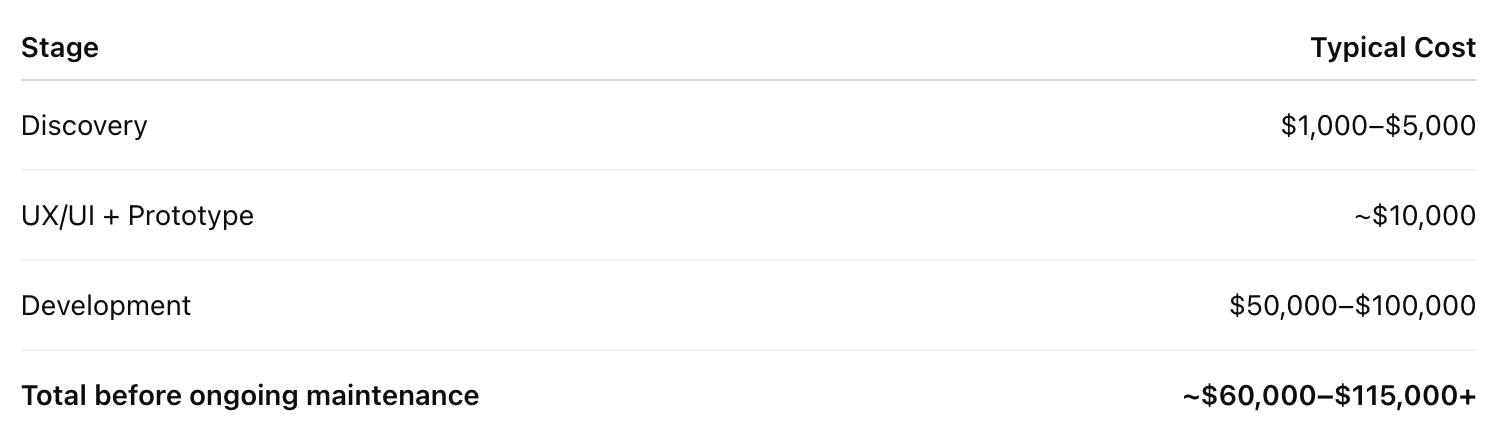
That is a much more realistic budget for serious software than the "$5,000 app development" offers you will find floating around the internet.
And there is one more cost founders frequently forget. The app still needs someone after it launches.
4. Post-Launch: Your App Does Not Maintain Itself
On paper, software runs automatically. You deploy it to a server, put the app on the App Store and theoretically walk away.
In reality, that is very rarely how software works.
Operating systems change. Apple releases new iOS versions. Android changes. Third-party APIs change. Libraries become outdated. Security vulnerabilities are discovered. Servers need attention. Users find bugs. Payment providers update requirements. Features that sounded perfect during development turn out to confuse users. And eventually, something breaks.
Someone needs to be responsible for the product every month. This is where ongoing retainers normally come in. There are generally two models.
Maintenance Retainer: Starting Around $5,000/Month
This is primarily about keeping the application healthy. The development team remains available to:
Fix bugs
Investigate production issues
Monitor the application
Update dependencies
Upgrade libraries
Keep iOS and Android versions compatible
Handle server-related issues
Address security concerns
Maintain integrations
Provide technical support
Think of this as keeping the machine running. For a serious application with a capable engineering team behind it, maintenance retainers can start around:
$5,000 per month
The exact number depends heavily on the size and complexity of the system.
Product Development Retainer: Starting Around $15,000/Month
The second model is very different. Instead of simply keeping the existing product alive, you have an engineering/product team continuously working on it. That means:
Building new features
Improving existing features
Analyzing user behavior
Fixing UX problems
Improving performance
Running experiments
Improving onboarding
Optimizing conversion
Updating infrastructure
Addressing technical debt
Scaling systems as usage grows
This is how successful software usually evolves. All software that you use online follow this version. Either they build their own team or hire an agency to do it
For a competent product and engineering team doing meaningful work every month, this type of retainer generally starts around:
$15,000 per month
It can go substantially higher depending on the size of the team.
But What If You Only Need an MVP?
This is where things have changed dramatically in the last few years. There is another route:
Build an MVP first
An MVP is not the same thing as the production-grade product described above. The goal is different. You are trying to answer:
Does anyone actually want this?
That means you intentionally postpone a lot of engineering. You may not build for massive scalability. You may not create sophisticated infrastructure. You may simplify administrative tools. You may accept more technical debt. You may use third-party services instead of building systems yourself.
You still shouldn't intentionally build broken or dangerously insecure software. But the engineering standard is different because the goal is to validate the product quickly, not support millions of users.
MVP Cost in 2026: Roughly $10,000 to $20,000
For many startup apps, a realistic MVP budget today is:
$10,000 to $20,000
And AI is one of the biggest reasons that number has fallen. A few years ago, MVPs regularly cost $50,000 or more. Some easily reached $100,000. Today, experienced engineers using modern AI development tools can produce the same amount of baseline functionality significantly faster.
Boilerplate gets written faster. Interfaces can be built faster. Basic APIs can be created faster. Tests can be generated faster.
Common development tasks that previously consumed days can sometimes be completed in hours. That reduction in engineering time has materially changed MVP economics.
MVP vs Production App: The Difference Matters
This is probably the most important distinction in the entire article.
MVP
Typical cost: $10K–$20K
Built to:
Validate the idea
Show investors
Get early customers
Test the market
Learn quickly
Prove demand
You knowingly accept shortcuts because speed matters more than perfection.
Production-Grade Application
Typical initial cost: $60K–$120K+
Built to:
Handle real users reliably
Protect customer data
Process transactions
Scale
Recover when something fails
Be monitored
Be maintained
Support continued development
Most software products you use every day are much closer to the second category. And that is where founders sometimes get into trouble. They pay MVP prices while expecting production-grade engineering. Those numbers simply do not match.
Can You Build an App for $5,000?
Yes. You can also build one for $2,000. Someone somewhere will probably offer to build one for $500. The more useful question is:
What exactly are you getting for that price?
There is always a trade-off between:
Scope
Speed
Engineering quality
Product quality
Reliability
Security
Team experience
Testing
Maintainability
Cheap software is not automatically bad software. And expensive software is definitely not automatically good software. We have audited products where companies spent tens of thousands of dollars and still ended up with engineering problems that should never have reached production.
Price alone does not tell you whether a team is competent. But if someone is promising a complicated production-ready application for a fraction of the engineering hours realistically required to build it, something has to give.
Usually, you discover what that "something" was later.
The Real Question Is Not "How Much Does an App Cost?"
It is:
What stage are you trying to reach?
If you have an idea and simply want to validate whether people will use it:
Budget around $10,000–$20,000 for an MVP.
If you already know the product needs to operate reliably, process real transactions, support customers and become a serious business:
Budget around $60,000–$120,000+ for the initial build.
And if the app becomes an active part of your business, expect ongoing engineering costs after launch. Software is rarely a one-time purchase. The first release simply gets you onto the field.
A Simple 2026 App Development Budget
If you are planning a new app today, here is the easiest way to think about it:
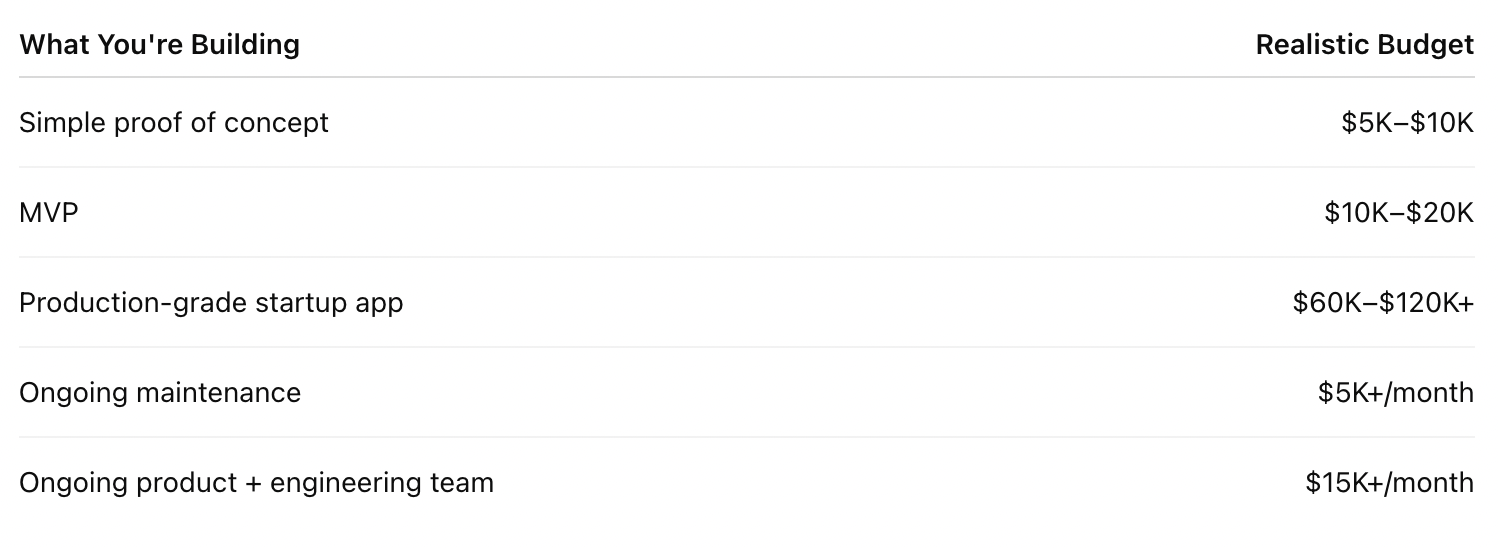
There will always be exceptions. But after working on 300+ software projects, these are much closer to the numbers we see in the real world.
And knowing which category you actually need before hiring a development team can save you a very expensive lesson later.
Need Help Estimating Your App?
If you're planning an app and aren't sure whether you need an MVP or a full production build, I can review the idea and help you map out the realistic scope, timeline and budget before you commit to development.
We are a New York-based product and engineering team and have worked on 300+ software projects since 2019.
Sometimes the most valuable thing you can learn before building software is what not to build yet.