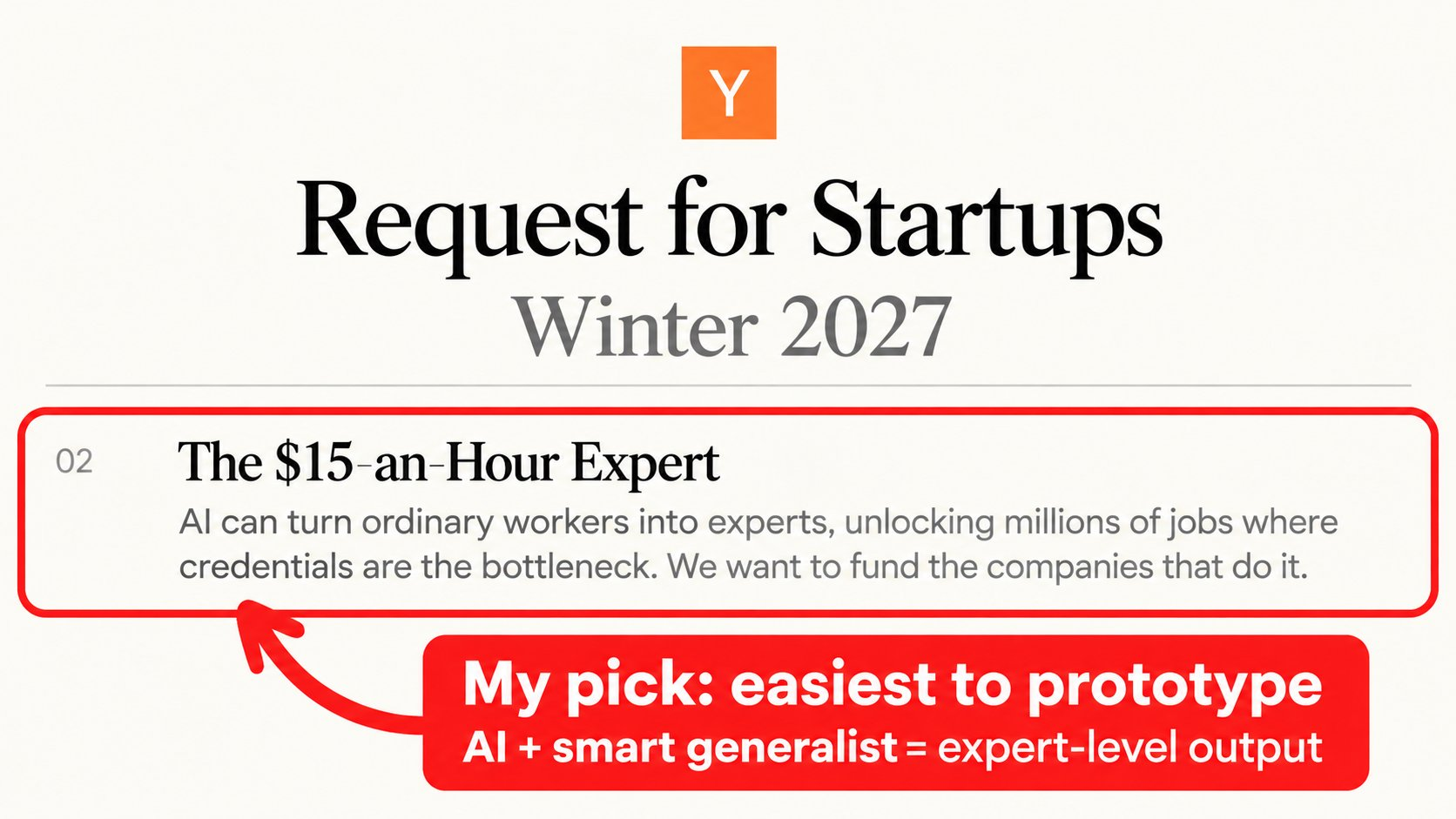
Y Combinator just dropped its Winter 2027 Request for Startups: 11 ideas it wants founders to build. The list has the expected moonshots. Startups for a world of cheap space access. Robots made in America. Wall Street for the physical buildout of AI.
One idea jumped out at me, and it is not one of the moonshots. It is idea number two: the $15-an-hour expert.
Of the 11, I think it may be the easiest one to prototype, and the one that says the most about where AI work is actually heading. It also describes, almost exactly, how good app development already works in 2026. Here is the idea, why YC is asking for it now, and the catch that will decide who wins it.
TL;DR: The latest YC Request for Startups asks founders to build companies where a smart generalist, equipped with strong AI tools, does work that used to require a $100-an-hour specialist. The gap between the $15 to $25 an hour the worker costs and the $100-plus an hour the output is worth is the business. The model works because the human stays in the loop: AI supplies the knowledge and the speed, the human supplies the judgment and the trust. That same human-in-the-loop pattern is now the dividing line in AI app development between apps that scale and apps that fall apart.
1. The idea, in plain words
YC describes it like this: AI can turn ordinary workers into experts, unlocking millions of jobs where credentials are the bottleneck.
The model, step by step:
Pick one narrow category where expert labour is expensive and the work is repetitive enough for AI to genuinely help. Taxes. Insurance claims. Medical billing. Immigration paperwork.
Hire smart generalists, not credentialed specialists. Capable people who are good with customers and good with AI tools.
Build the workflow around the human plus AI combination, so the generalist produces output at the level the specialist used to.
Sell the outcome, not the hours. The customer gets expert-level work at a price the old model could never offer.
You are not replacing the expert with AI. You are making a $15 to $25 an hour person capable of producing work that historically required someone charging $100 an hour or more. That gap is the business.
And unlike robots, data centres or space startups, you could test something like this with real customers almost immediately. No hardware, no launch costs, no years of research. A workflow, a few customers, and proof that the output holds up.
2. Why YC is asking for this now
This idea is on the list because three things became true at the same time:
AI got good enough to lift, not just assist. On structured, knowledge-heavy work, a well-equipped generalist can now reach output that used to take years of training. The knowledge bottleneck YC names is real: in many service categories, the scarce thing was never effort, it was knowing what the expert knows.
Pure automation kept hitting the same wall. Fully automated services stall on edge cases, exceptions and accountability. When a tax filing is wrong, somebody has to answer for it. Customers in high-stakes categories do not buy software output. They buy an outcome someone stands behind.
Services are the biggest markets software never cracked. Software margins came from replacing labour with code. AI-augmented services attack the same markets from the other side: keep the human, remove the cost structure that made the service expensive.
Put together, this is the human-in-the-loop model going mainstream. AI does the heavy lifting, a person stays responsible for the result, and the economics change completely.
The pattern to notice: the winning model is not AI instead of people. It is AI underneath people, with the people moved up to the work that actually needs a person.
If you are thinking of applying, the timing is real: on-time applications for the Winter 2027 batch close on November 2, 2026. But even if YC is not your path, the idea is worth stealing, because it travels well beyond services.
3. The catch: expert-level output needs expert-level checking
Here is the part that will decide who wins this category, and it is easy to miss in the excitement.
AI output is fluent. Fluent is not the same as correct. A generalist with great tools can produce a claim, a filing or a contract review that reads perfectly and is wrong in the one place that matters. In these categories, errors are not typos. A wrong filing costs a client money. A mishandled claim costs them coverage. The customer is buying certainty, not drafts.
So the real product in a $15-an-hour expert company is not the AI workflow. It is the checking layer:
Standards set by real experts, who define what good output looks like and where the traps are.
Review built into the workflow, so edge cases and high-stakes calls get escalated to a human who actually knows.
Feedback loops, where every caught mistake makes the workflow stricter for the next customer.
The companies that treat the human as a rubber stamp will produce cheap work that is quietly unreliable, and the market will find out the expensive way. The companies that build expert-in-the-loop properly will be able to charge for trust, which is the one thing AI alone still cannot sell.
4. This is already how good app development works
If this model sounds familiar, it should. It is the same shift that has already happened in software, and it is the reason we wrote about why AI-generated apps keep shipping with security vulnerabilities.
AI writes code at remarkable speed. But unreviewed AI output mirrors the average public code it learned from, which is MVP code: OTPs returned inside API responses, keys exposed in the app, passwords hashed the quick way instead of the safe way. The code works. It demos beautifully. It is not production-grade, because nobody with experience checked it against production standards.
The teams getting this right run the $15-an-hour expert model in reverse. Their engineers are the experts, and AI is the leverage underneath them:
AI handles the volume: scaffolding, boilerplate, first drafts of features, the repetitive parts of a build.
Experienced engineers handle the judgment: architecture, security, data design, and the thousand small calls that decide whether an app survives real users.
The client gets the gap: senior-level output, produced faster than a traditional senior-only team could produce it.
That is the model we run at Code Baiz, and it is why the "AI will replace developers" framing keeps missing. AI replaces tasks. It raises the value of the people who can tell good output from bad, because there is now far more output to judge.
5. What this means for you, depending on which side you are on
If you want to build a $15-an-hour expert startup, your first product is not an app. It is a workflow and a standard. Prototype it manually: do the work yourself with AI tools for five real customers, measure your output against what a specialist would have delivered, and find where the AI quietly fails. That failure list is your actual product spec. When the workflow holds up, then you build software around it, and the jump from that prototype to something customers can trust with real data is exactly the road in our guide on how to take an MVP to production.
The categories worth picking share four traits:
The specialist is genuinely expensive, so the gap between your cost and the going rate is wide enough to build a business inside it.
The work is repetitive and rules-based, with the same kinds of cases arriving every week, so a workflow can actually be built and improved.
The output can be checked, because expert-in-the-loop only works when "correct" is verifiable, not a matter of taste.
The customer feels the current cost directly, in fees, delays or rejected paperwork, so a cheaper and faster expert-level outcome sells itself.
If you are hiring anyone to build your app with AI, steal YC's framing and ask the expert-in-the-loop questions:
Who checks the AI's output, and what have they shipped before?
What are your production standards for security, data and releases, and how do you verify them? A production-readiness audit is a good template for what "verified" should mean.
When the AI produces something wrong, and it will, what catches it before your users do?
A team that can answer those clearly is selling expertise with leverage. A team that cannot is selling you the average of the internet, typed faster.
Frequently asked questions
What is the $15-an-hour expert? It is one of the 11 ideas in YC's Winter 2027 Request for Startups. The model: hire smart generalists, equip them with strong AI tools and a workflow with expert checking built in, and sell work that used to require specialists charging $100 an hour or more, at a cost base of $15 to $25 an hour.
What is Y Combinator's Request for Startups? It is the list YC publishes each batch naming the kinds of companies it wants to fund. The Winter 2027 list has 11 ideas, from space access and American-made robots to the $15-an-hour expert. On-time applications for the batch close November 2, 2026.
Is AI replacing experts? Not in this model. AI is replacing the scarcity of expert knowledge on routine work, while experts move to the top of the loop: setting standards, handling edge cases and standing behind the result. The generalist plus AI handles volume. The expert guarantees it.
Does the $15-an-hour expert model apply to app development? Yes, and it already does. AI tools produce code quickly, experienced engineers review and harden it, and customers get senior-level apps faster than a traditional build. The failures happen when the expert layer is skipped and unreviewed AI output goes straight to production.
Build the version with experts in the loop
Whether you are prototyping a service from YC's list or fixing an app that AI built without supervision, the shape of the work is the same: move fast on the build, be strict on the checking. If you want a second pair of expert eyes on an app, or a team that builds this way from day one, our free check covers the product and the engineering, and you keep the findings either way.
Code Baiz is a mobile and web app development agency in Brooklyn, NYC, with a team of around 20 engineers and 300+ projects launched since 2019. We build new apps, and we fix and rebuild ones that were not built properly the first time.